Best Solar Battery Deals in NSW 2026: What Homeowners Need to Know Before Buying

Best Solar Battery Deals in NSW 2026: What Homeowners Need to Know Before Buying

Electricity prices and the growing popularity of rooftop solar have encouraged more NSW homeowners to consider adding battery storage to their homes.

But choosing a solar battery should not be based only on the advertised price.

Battery capacity, usable energy, solar system size, inverter compatibility, household consumption, backup requirements and installation conditions can all affect which battery system is suitable for a property.

There is also significant interest in battery installations because eligible households and businesses can access support under the Australian Government's Cheaper Home Batteries Program. The program provides an upfront discount through the Small-scale Renewable Energy Scheme, with the government stating that support remains around 30% for a range of eligible battery sizes following program changes that took effect on 1 May 2026. The actual benefit varies according to the system and applicable STC calculations.

At UR Needs Pty Ltd, we help NSW homeowners understand their solar and battery requirements and obtain a system proposal based on their property, electricity usage and energy goals.

Looking for a solar battery deal? Call UR Needs on 0449 916 688 for pricing and system sizing options.


Is a Home Battery Worth Considering in NSW?

A home battery allows surplus electricity produced by solar panels to be stored for later use.

For example, a home may generate significant solar electricity in the middle of the day when nobody is home. Without battery storage, unused electricity may be exported to the grid.

With a suitably designed battery system, some of that surplus energy can instead be stored and used later in the afternoon, evening or overnight.

Depending on the system configuration, a battery may also support:

  • greater use of electricity generated by your own solar system;
  • reduced dependence on electricity imported from the grid;
  • energy use during higher-cost periods;
  • backup capability where the system has been specifically designed and configured for backup operation.

The right outcome depends heavily on the household's actual electricity consumption profile. A larger battery is not automatically a better battery. The Australian Government also recommends considering daily electricity usage, solar output and inverter capacity when selecting battery size.


How Does the 2026 Home Battery Discount Work?

The Australian Government's Cheaper Home Batteries Program supports eligible small-scale battery installations through the Small-scale Renewable Energy Scheme.

Under the current rules, the program continues to support eligible battery systems between 5 kWh and 100 kWh nominal capacity, while STC support applies to the first 50 kWh of usable capacity. Eligibility requirements include approved battery products and appropriately accredited installation.

The rules changed from 1 May 2026. The program now uses different support levels across portions of battery capacity, while the government states that the intention is to maintain a discount of around 30% across a range of appropriately sized systems.

This is important because advertisements that simply promise the same rebate amount for every battery size can be misleading. The actual benefit can depend on factors including:

battery usable capacity, applicable STC factor, installation date, system configuration and eligibility.

For homeowners, the practical approach is to request a properly itemised proposal showing the system configuration and applicable discount rather than comparing only one headline price.


What Size Solar Battery Should You Buy?

There is no single battery size that is right for every NSW home.

Before recommending a system, the following should be reviewed:

Your daily electricity consumption

A household using 15 kWh per day has very different storage requirements from a large household using 40 or 50 kWh per day.

When electricity is consumed

Two properties with similar electricity bills can need different battery systems.

One family may use most electricity during daylight hours, while another may have high evening consumption from air conditioning, cooking, pool equipment, electric hot water or EV charging.

Existing solar capacity

The battery needs an energy source.

Installing a very large battery on a property with limited surplus solar production may not produce the expected result unless there is a clear strategy for how that battery will be charged and used.

Single-phase or three-phase power

The electrical configuration of the property can affect inverter and battery system design.

Backup requirements

Homeowners should clearly explain what they expect during a blackout.

There is an important difference between:

“I want a battery”

and:

“I need the battery to run selected essential circuits during a blackout.”

Backup configuration needs to be assessed as part of system design.


What Should You Compare When Looking for the Best Solar Battery Deal?

The cheapest advertised battery price is not necessarily the lowest total installed cost.

A proper comparison should consider the whole system.

1. Battery capacity

Check both the advertised capacity and the usable capacity.

2. Inverter compatibility

The battery system must work correctly with the selected inverter architecture and the property's existing solar equipment.

3. Installation scope

Ask what the quotation includes.

Depending on the property, installation requirements can differ significantly.

4. Outdoor suitability

For an outdoor installation, check the manufacturer's installation requirements and environmental protection rating applicable to the specific model being quoted.

5. Charging and discharging capability

A battery's capacity tells you how much energy it stores. Its power and charge/discharge characteristics affect how that energy can be delivered and replenished.

6. Safety systems

Review the battery's integrated safety features, system architecture and installation requirements.

7. Warranty

Compare the actual written warranty conditions rather than relying only on a headline number of years.

8. Monitoring

A good monitoring platform can help homeowners understand:

  • solar generation;
  • household consumption;
  • battery charging;
  • battery discharging;
  • grid import;
  • grid export.

Dyness Stack 100 Pro Battery Storage in NSW

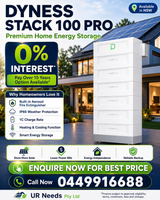
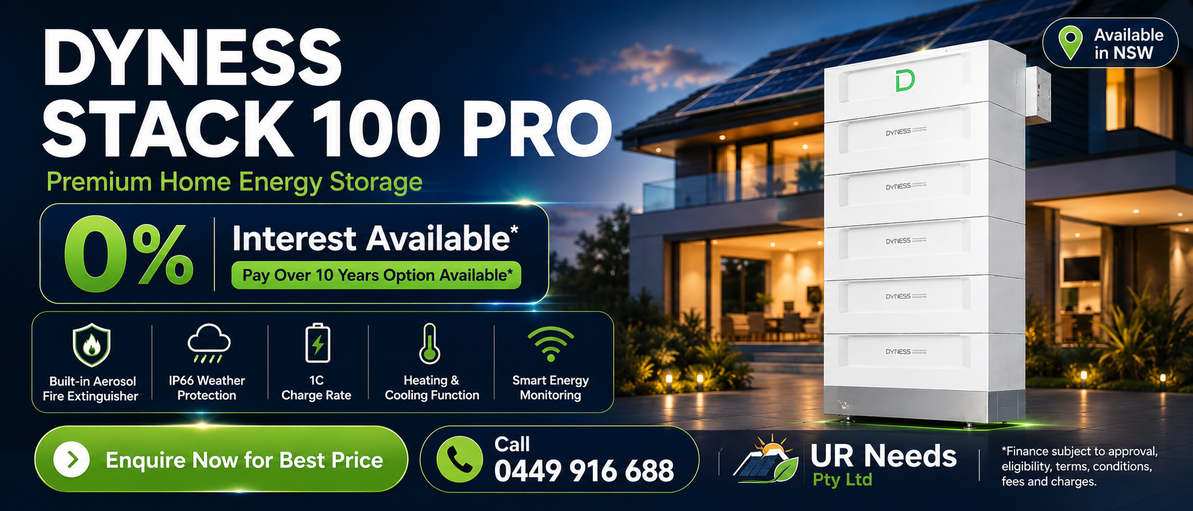
For customers looking at larger and scalable battery storage solutions, UR Needs offers the Dyness Stack 100 Pro as one of the available battery options, subject to property assessment and system compatibility.

Key product features include:

✅ Built-in aerosol fire extinguisher
✅ IP66 weather protection
✅ 1C charge rate
✅ Heating and cooling function
✅ Scalable battery capacity
✅ Smart energy monitoring
✅ Residential solar and backup applications, subject to system design and configuration

The right system configuration should be determined after reviewing your property and energy requirements rather than simply selecting the biggest available battery.

For eligible installations under the federal program, battery products and relevant equipment must satisfy program requirements, and installations must meet the applicable accreditation and safety requirements. The Clean Energy Regulator states that eligible solar battery installations must use approved products and appropriately trained, licensed and accredited installers.


Can You Add a Battery to an Existing Solar System?

In many cases, yes.

An eligible battery can be installed alongside an existing solar PV system, although technical suitability still needs to be assessed.

Important checks include:

  • the condition of the existing solar system;
  • inverter type and configuration;
  • solar system capacity;
  • available switchboard capacity;
  • phase configuration;
  • proposed battery location;
  • network requirements;
  • whether backup functionality is required.

The Clean Energy Regulator confirms that batteries can be installed with eligible existing solar PV systems, but specific compliance and inverter requirements apply.

This is why UR Needs recommends assessing the existing equipment before preparing the final installation proposal.


Solar Battery Finance Options

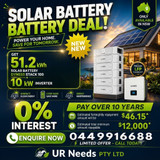
For eligible customers, 0% interest options may be available, subject to approval, eligibility, terms, conditions, fees and charges.

Longer repayment options may also be available depending on the approved finance arrangement.

Before accepting any finance offer, customers should review:

  • repayment amount;
  • repayment period;
  • establishment or other applicable fees;
  • total amount payable;
  • approval criteria;
  • finance terms and conditions.

Finance is subject to approval, eligibility, terms, conditions, fees and charges.


Get a Solar Battery Quote in NSW

There is no universal “best battery” for every home.

The best system is one that is appropriately designed around:

your existing solar system, electricity consumption, available surplus solar energy, evening electricity usage, backup requirements, available installation space and budget.

UR Needs can help you review available solar and battery options and provide a proposal based on your requirements.

? Looking for a solar battery deal in NSW?

Contact UR Needs Pty Ltd

? Call: 0449 916 688

? Available in NSW

Ask us about:

Solar battery installation
Dyness Stack 100 Pro options
Solar and battery packages
Battery system sizing
Backup system options
0% interest options for eligible customers*

Enquire today for our best available price and a system proposal based on your property.

Finance is subject to approval, eligibility, terms, conditions, fees and charges. System eligibility, configuration, pricing and installation requirements vary by property.

7th Jul 2026 Karan Chopra

Recent Posts